Cambridge Cognitive Architecture
News
Updates
Space Architecture at NASA
Paper Accepted at SpaceCHI 2026
Paper titled 'SPACE4SPACE: Linking Habitat Spatial Configuration to Team Health Through Observed Co-Presence in a 14-Day Space Analogue Mission' accepted for presentation at SpaceCHI 2026 (Sept 24–25, 2026) at the NASA Ames Conference Center in Mountain View, California.
Humboldt Guest Lecture
Colloquium Talk at TU Berlin (BeMoBIL)
Delivered a colloquium talk at the TU Berlin Mobile Brain/Body Imaging Lab (BeMoBIL / MoBI Lab) as part of research conducted under the Alexander von Humboldt Fellowship.
Creative Cambridge Panelist
Invited Panelist at Creative Cambridge
Inclusive Innovation – What makes a creative city? Asst Prof Dr Michal Gath-Morad sat on the opening panel, exploring how collaboration, policy and place can come together to support more inclusive innovation in Cambridge. From shaping the built environment to strengthening creative and cultural ecosystem. Panelists: Ivan Collister (Chair), Eleanor Fawcett, Dr Michal Gath-Morad, Nema Hart, Dr Cathy K.
Cognitive Design Keynote
Keynote at Arquitectonics Congress (Barcelona)
Asst Prof Dr Michal Gath-Morad will deliver a keynote speech at the international Arquitectonics Congress in Barcelona, Spain (June 2026), presenting CCA's cognitive science-empowered design paradigm.
Design Education Panel
Invited Panelist at AIS Week Kyoto Round Table
Asst Prof Dr Michal Gath-Morad was invited as a panelist for the AIS Week Kyoto Round Table to discuss ethical and pedagogical frameworks for incorporating psychophysiological data into architectural design studio education.
RIBA Journal Feature
RIBA Journal (RIBAJ) Keynote Feature
Keynote article and interview by Asst Prof Dr Michal Gath-Morad for the Royal Institute of British Architects Journal (RIBAJ) exploring how cognitive neuroscience transforms contemporary architectural practice.
Public Health Poster
Salome Egli Presents Poster at East of England Public Health Research Conference
CCA Doctoral Researcher Salome Egli presented her PhD research poster on spatial predictability and stress in Emergency Departments at the East of England Public Health Research Conference organized by NIHR SPHR in Cambridge.
Analogue Astronaut Selection
Aurora Chenxi Wang Selected for Analogue Space Mission
CCA Doctoral Researcher Aurora Chenxi Wang was selected as an analogue astronaut for an isolated habitat mission at the LunAres Analogue Station, expanding CCA's SPACE4SPACE initiative into extreme habitat architecture.
Cambridge Architecture Award
Haining Ding Awarded the Alexander Pike Prize
CCA Doctoral Researcher Haining Ding was awarded the Alexander Pike Prize by the Department of Architecture at the University of Cambridge for his project URBAN-SPIN, supervised by Asst Prof Dr Michal Gath-Morad.
Humboldt Research Fellowship
Alexander von Humboldt Fellowship Awarded to Asst Prof Dr Michal Gath-Morad
Asst Prof Dr Michal Gath-Morad was awarded the prestigious Humboldt Research Fellowship for a two-year collaborative research project with Prof Klaus Gramann at the Mobile Brain/Body Imaging (MoBI) Lab, TU Berlin.
CRASSH Lab Launch
CRASSH Lab Seed Funding Awarded to Establish NeuroCīvitās
CRASSH Lab Seed Funding was awarded to Asst Prof Dr Michal Gath-Morad to launch NeuroCīvitās, an interdisciplinary initiative uniting architecture, neuroscience, psychiatry, and engineering across the University of Cambridge.
Projects
Selected work
Introduces a perception-led, typology-based framework for evaluating cycling experience in historic city centres. Combines a new first-person video dataset (the Cambridge Cycling Experience Video Dataset) with computer-vision-derived streetscape indicators and a resident survey to build a typology-sensitive Bikeability Index, and shows that targeted visual redesigns can meaningfully improve perceived bikeability without large-scale structural change.
View project ↗Seed funding from CRASSH to establish an interdisciplinary lab where history, theory, neuroscience and engineering converge to creatively rethink the role of architectural design in mental and brain health.
View project ↗Agent-based occupant simulation combined with participatory co-design methods to optimise healthcare architecture for user experience and spatial performance. Completed under an SNF Postdoc.Mobility fellowship.
View project ↗Investigates how the physical and social structure of cities shapes visual attention and locomotion during real-world walking. Combining wearable eye tracking, foot-mounted inertial sensors, GPS, egocentric computer vision, and urban configurational analysis, LocoGaze examines how terrain irregularity, pedestrian density, and the proximity and movement of others influence gaze strategies and gait, revealing continuous visuomotor adaptation to the built environment.
View project ↗A collection of 25 articles by 37 emerging voices in urban design and research, exploring how future cities can be made more liveable, sustainable, and resilient, spanning socio-cultural, socio-economic, policy, public health, environmental, and urban data science perspectives.
View project ↗Prototyping a closed-loop Brain-Architecture Interface where real-time neural and physiological data (EEG, HRV, EDA) drive dynamic spatial shifts, entraining brain and body responses through architectural rhythms and visual enclosure. Developed using Mobile Brain/Body Imaging (BeMoBIL, TU Berlin & Cambridge, Humboldt Fellowship 2026–2028).
View project ↗LIMINEX investigates how the spatial and sensory features of transitional spaces—comprising 40% of building interiors—shape occupants' affective states, visual attention, and emotional regulation during movement. By integrating allocentric plan-level analysis (VGA on 180 floorplans) with egocentric scene-level computer vision pipelines (131 video walkthroughs), LIMINEX translates empirical spatial analytics into pre-occupancy design tools for healthcare, workplace, and educational environments.
View project ↗Investigates how internal spatial configuration shapes crew movement, co-presence, and individual/team health outcomes in Isolated, Confined, and Extreme (ICE) environments. Integrates the SpaceTrace CCTV-to-floorplan computer vision pipeline (YOLOv11, ReID), space syntax, 3D LiDAR scanning, and daily psychophysiological tracking (HRV) validated during a 14-day mission at LunAres Research Station.
View project ↗FORESIGHT investigates how spatial configuration shapes cognitive load and stress in high-demand healthcare settings. Combining Lidar point cloud capture of a live Emergency Department with space syntax, naturalistic mobile eye tracking, psychophysiological sensing, and EMR patient outcome data, the project establishes spatial predictability as a key driver of cognitive effort to inform design strategies that reduce clinical error and stress.
View project ↗Introduces the Cambridge Facade Affect Dataset (86 rectified facade images rated by 85 participants) and links machine-vision-derived facade metrics — complexity, transparency and materiality — to human arousal and valence ratings. Perceived complexity emerges as the dominant predictor of affective response, with human perceptual judgement mediating the relationship between machine-derived metrics and how a facade actually feels.
View project ↗Investigates how the spatial design of Emergency Departments shapes face-to-face interaction among healthcare workers, and how this in turn affects communication, collaboration and patient care quality — to inform evidence-based, human-centric design of EDs as critical entry points into hospital care.
View project ↗A proof-of-concept project at our CCA lab premises, where we equipped our own spaces with occupancy and environmental sensors, with specific campaigns to test how changes in our office layouts (collaborative vs. focus work) shape attention, occupancy, and interactions.
View project ↗Mission
Three Research Pillars
Our mission is to quantify how built environments affect cognition, behaviour and health and apply that evidence to design humane environments.
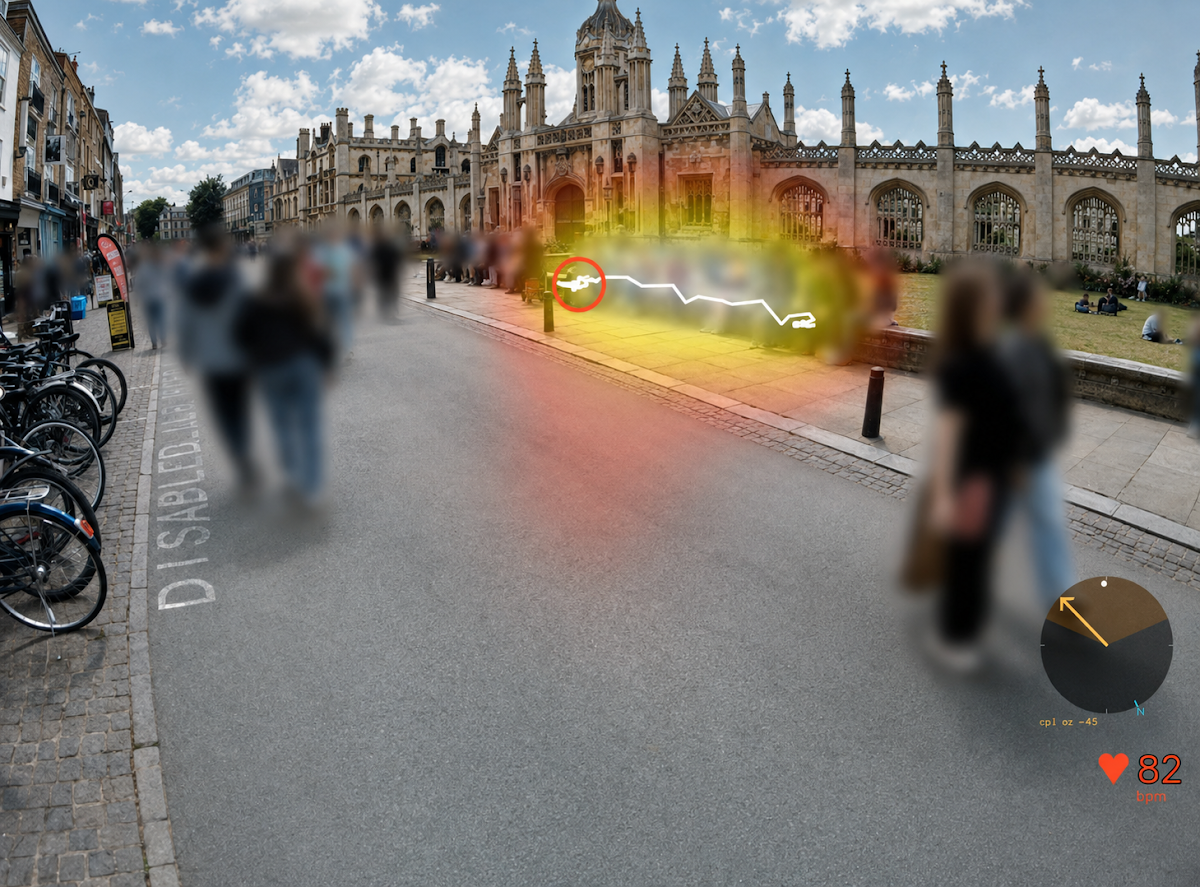
Real-world capture
of spatial and social cognition
Most evidence on how people experience buildings comes from laboratory studies. Measuring in real buildings is challenging: the signals are noisier, and the measurement itself can change what people do, and there are various ethical challenges.
We work in high-risk, high-stress settings, from emergency departments and clinical wards to analogue space habitats, using a combination of quantitative and qualitative methods to record movement, arousal and interaction, ranging from ethnography and interviews to wearable psychophysiology, environmental sensors and computer vision.
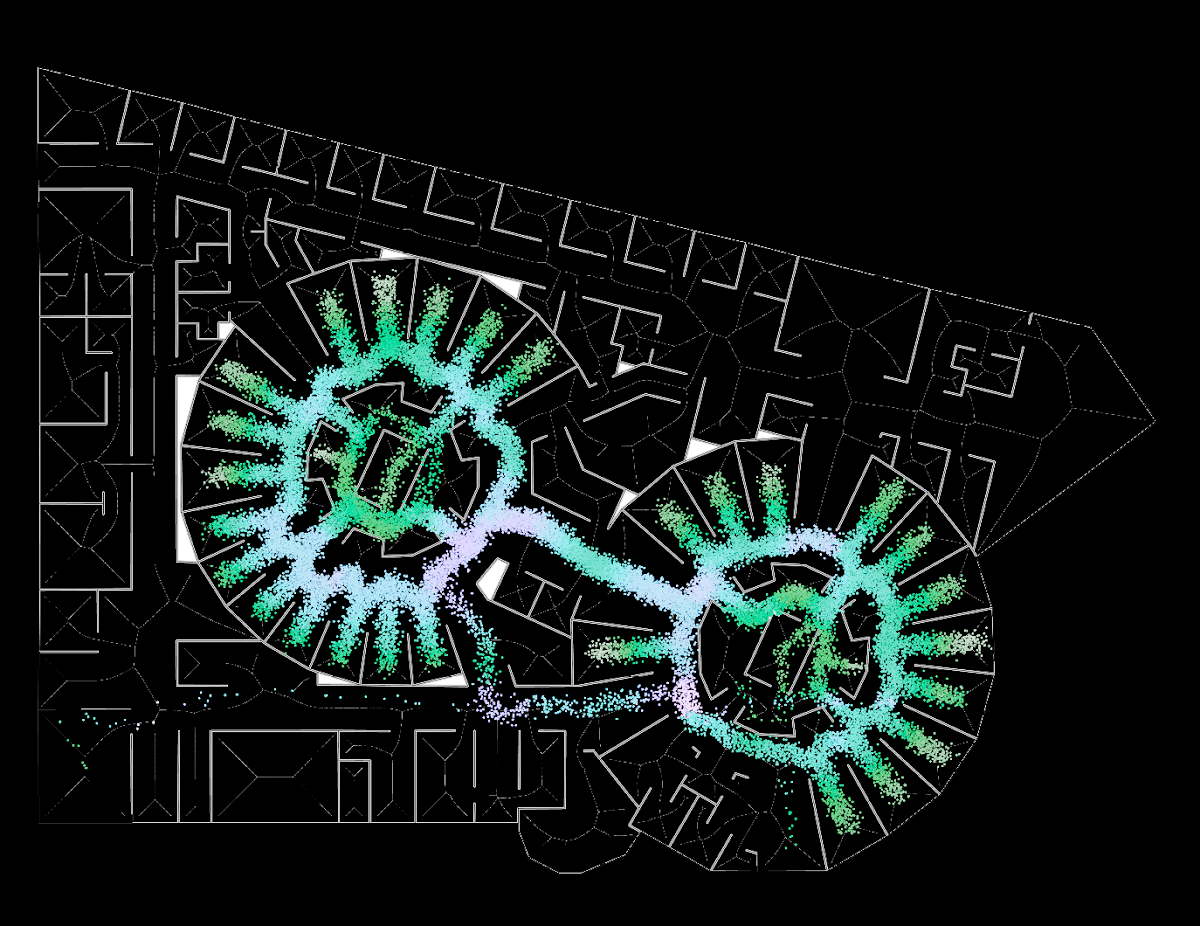
Behavioural experiments
to test design hypotheses
In an occupied building, natural variation in spatial configuration is confounded with a range of factors, from staffing to occupancy flow. To complement our work on how naturalistic variation in real-world configurations affects cognition and behaviour, we run controlled behavioural experiments and build cognitively grounded agent-based models that isolate the effect of specific features (curvature, enclosure, visibility, functional allocation) on a range of outcome measures.
Each experimental setting trades realism for control. Virtual reality lets many design variants be tested cheaply and safely, but constrains locomotion, scale cues and sensory detail. Augmented reality keeps the body in a real space, with its real acoustics and materials, while altering what is seen, so it suits targeted manipulations rather than wholesale reconfiguration. Full-scale mockups restore material, acoustic and social presence, at the cost of building only a handful of variants. None of them is the real world, so we choose the setting to match the hypothesis and, where it matters, test the same question in more than one.
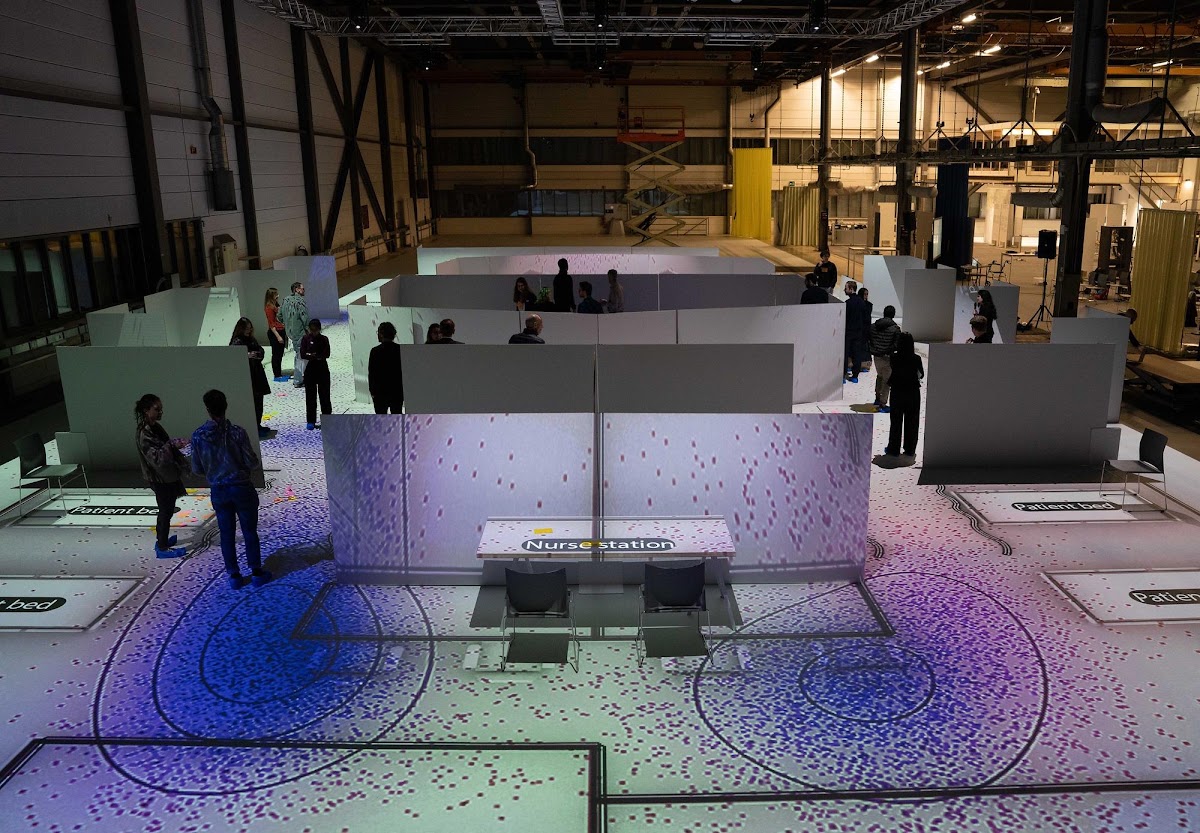
Co-design with evidence
on human cognition
Evidence only matters if it reaches the people making decisions. Reasoning about unbuilt space imposes a high working memory load, and co-design brings together stakeholders with very different spatial abilities, so imagining how a design will shape behaviour is far easier for some people than for others.
We therefore treat co-design as an experimental setting in its own right: spatial visualisations and full-scale mockups place the evidence onto the configuration under discussion, and wearables give us insight into where a group coheres, where it diverges and where decisions stall. Evidence stays open to challenge and refinement. To speed up the exploration of design spaces, we also develop generative simulation tools that help clinical, institutional and policy partners link design decisions to cognitive and health outcomes.
Team
Click for bio
Alumni
- Leonel AguilarVisiting Scholar, 2025
- Aurora Chenxi WangMPhil, 2025
- Haining DingMPhil, 2025
- Xiangfeng ZhouMPhil, 2024
Publications
Selected outputs
Crossing paths: Social and environmental contexts shape visual attention and gait during urban walking
SSRN
Gaze sharing: A survey of its applications in education and future directions
Computers & Education: X Reality
Spatial and operational interventions for healthy cruise ship design using agent-based modelling
Travel Behaviour and Society
A systematic review: Affective perception on urban facades
arXiv
Generative AI for architectural façade design: Measuring perceptual alignment across geographical, objective, and affective descriptors
Buildings
How built environment shapes cycling experience: A multi-scale review in historical urban contexts
arXiv
‘Rightsize’: A housing design game for spatial and energy sufficiency
Buildings and Cities
Attract or repel: How street features shape pedestrians' leisure walks in cities
Journal of Urban Design
Biophilic design elements and natural materials in healthcare environments
Journal of Green Building
Designing affective workplace environments: The impact of typology, contour, ceiling and partition height on cognitive and aesthetic appraisal
Building and Environment
Experiments as Code and its application to VR studies in human-building interaction
Scientific Reports
The role of strategic visibility in shaping wayfinding behavior in multilevel buildings
Scientific Reports
DesignMind toolkit (software)
Zenodo
The DesignMind toolkit: A toolkit for evidence-based, cognitively-informed and human-centred architectural design
eCAADe 2023: Digital Design Reconsidered
Architectural cognition cards: A card-based method for introducing spatial cognition research and user-centred thinking into the design process
Architectural Science Review
Beyond the shortest-path: Towards cognitive occupancy modeling in BIM
Automation in Construction
Cognitively grounded floorplan optimization to nudge occupant route choices
SSRN
Dense indoor sensor networks: Towards passively sensing human presence with LoRaWAN
Pervasive and Mobile Computing
The hitchhiker's guide to Fused Twins: A review of access to digital twins in situ in smart cities
Remote Sensing
Experiments as Code: A concept for reproducible, auditable, debuggable, reusable, & scalable experiments
arXiv
Fused Twins: A cognitive approach to augmented reality media architecture
Proceedings of the 5th Media Architecture Biennale Conference, MAB20
Visibility matters during wayfinding in the vertical
Scientific Reports
Visibility matters during wayfinding in the vertical (vol 11, 18980, 2021)
Scientific Reports
AUTOSIGN: A multi-criteria optimization approach to computer aided design of signage layouts in complex buildings
Computers & Graphics
cogARCH: Simulating wayfinding by architecture in multilevel buildings
Proceedings of the 11th Annual Symposium on Simulation for Architecture and Urban Design (SimAUD 2020)
Simulating the impact of facility design on operations: A study in an internal medicine ward
Facilities
A dashboard model to support spatio-temporal analysis of simulated human behavior in future built environments
Proceedings of the 9th Annual Symposium on Simulation for Architecture and Urban Design (SimAUD 2018)
How smart is the smart city? Assessing the impact of ICT on cities
Agent Based Modelling of Urban Systems, Abmus 2016
A computational framework to simulate human spatial behavior in built environments
Proceedings of the Symposium on Simulation for Architecture and Urban Design (SimAUD 2016)
Funding & Support
Partners and funders